One of the biggest challenges for me while writing SPOTD was finding a villain. And you don't have much of a superhero without a decent villain to act as a foil.
In fact, the villains tend to steal the show.
I struggled finding SPOTD's villain because I didn't want him (or her) to be cliched. And a bully is a big cliche. Even more than that, I didn't want Chase to fill the cliche of a bullied kid. Eventually I realized that Chase's sister Addy could be the target of the bullying, and the unfortunate Billy Bully was born.
Even though Billy is present from chapter one, Chase doesn't see him as dangerous. He is blind to his sister's situation. He must first overcome the villainous part of his own personality -- how he mistreats his sister Addy. Then he can see her problems and step into the role of protector.
Once again, I am faced with the challenge of finding villains. This time, they need to be plentiful. And to my surprise, this time they have been easier to write.
All I had to do was let them start killing people.
Monday, May 2, 2016


What I Learned in November
It is true, what successful writers say about the writing process.
To write a novel, one must have enough discipline to sacrifice other pleasures.
Stephanie Perkins puts it this way:
You write. That’s the hard bit that nobody sees. You write on the good days and you write on the lousy days. Like a shark, you have to keep moving forward or you die. Writing may or may not be your salvation; it might or might not be your destiny. But that does not matter. What matters right now are the words, one after another. Find the next word. Write it down. Repeat. Repeat. Repeat.
And as Pat Rothfuss puts it:
So last November, I wrote.
And I learned that Ms. Perkins, Mr. Gaiman, and Pat were soooo right.
Here's my 2015 chart:

You'll notice my wordcount flatline on day 10. Even though I hadn't finished the Kostova, I went to book club. That loss of time plus post-wine lethargy led to a few late evening hours of organizing my thoughts, but no new words in the story. Skipping the actual writing taught me that even if I had to stay up past midnight to put in my time, skipping a day of writing is not worth the extra sleep.
My mother called what happened for me this past November "momentum," and she was right. Writing a novel is like jumping onto a moving train. You can't reach your destination without the courage to make the leap, every day. I have to thank Nanowrimo for pointing me in the direction of a slow but steady train. I didn't "win" the month, at only 40,000 words. But I love the story I am writing. And I love the writing of it.
Next up: An update.
To write a novel, one must have enough discipline to sacrifice other pleasures.
Stephanie Perkins puts it this way:
Novels aren’t written by muses who come down through the ceiling and shoot magic through your fingers and out onto your laptop’s keyboard. Before NaNoWriMo, some teensy part of me still believed that because writing is a creative act, it should feel easy. But fairies don’t write novels. They’re written with one simple equation: Time + Work = Novel
Neil Gaiman puts it this way:You write. That’s the hard bit that nobody sees. You write on the good days and you write on the lousy days. Like a shark, you have to keep moving forward or you die. Writing may or may not be your salvation; it might or might not be your destiny. But that does not matter. What matters right now are the words, one after another. Find the next word. Write it down. Repeat. Repeat. Repeat.
And as Pat Rothfuss puts it:
1. Yay, Verily. You Must Sit Down and Write.
1a. Thou shalt not go see a movie instead. Or watch reality TV. Thou shalt write. No. Stop. You don’t need to clean out the fridge right now. Neither dost thou need to sort the recycling. I’m not even kidding. Go and write.
1b. Thou shalt not just think about writing. Seriously. That is not writing. The worst unpublished novel of all-time is better than the brilliant idea you have in your head. Why? Because the worst novel ever is written down. That means it’s a book, while your idea is just an idle fancy. My dog used to dream about chasing rabbits; she didn’t write a novel about chasing rabbits. There is a difference.
1c. Thou shalt not read, either. I know it’s book-related, but it’s not actually writing. Yes, even if it’s a book about how to write. Yes, even if you’re doing research. You can research later. Sit. Down. Write. PSo last November, I wrote.
And I learned that Ms. Perkins, Mr. Gaiman, and Pat were soooo right.
Here's my 2015 chart:
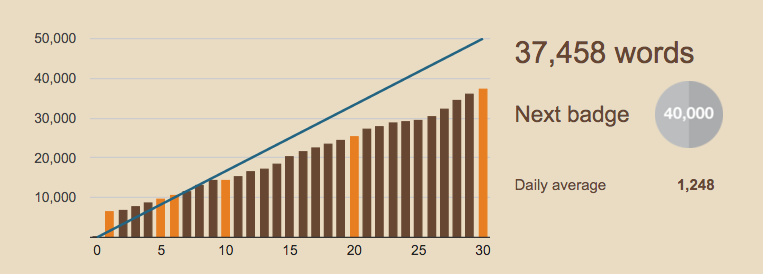
You'll notice my wordcount flatline on day 10. Even though I hadn't finished the Kostova, I went to book club. That loss of time plus post-wine lethargy led to a few late evening hours of organizing my thoughts, but no new words in the story. Skipping the actual writing taught me that even if I had to stay up past midnight to put in my time, skipping a day of writing is not worth the extra sleep.
My mother called what happened for me this past November "momentum," and she was right. Writing a novel is like jumping onto a moving train. You can't reach your destination without the courage to make the leap, every day. I have to thank Nanowrimo for pointing me in the direction of a slow but steady train. I didn't "win" the month, at only 40,000 words. But I love the story I am writing. And I love the writing of it.
Next up: An update.
Progress and Inspiration (with too many ellipses)
So last summer I...
... spent a lot of time in my head, world building
... rationalized time spend reading as time preparing to write (lots of Flanagan)
... hashed out quite a bit of my new story's plot, mostly while driving
... revised the 6000 or so words I had written in February/March
... researched castles by visiting British castles and
... did not write a word of actual story.
Then this happened...

Which looked like this...

And this...

And this...

Which looked like this...

And I realized I would rather be on the stage than in the crowd.
... spent a lot of time in my head, world building
... rationalized time spend reading as time preparing to write (lots of Flanagan)
... hashed out quite a bit of my new story's plot, mostly while driving
... revised the 6000 or so words I had written in February/March
... researched castles by visiting British castles and
... did not write a word of actual story.
Then this happened...

Which looked like this...

And this...

And this...

Which looked like this...

And I realized I would rather be on the stage than in the crowd.
So This Happened (November)
Last November, this did not happen:
This did happen:
This also happened:
Followed by this:
A pile of this happened:


(the reading did not)
And a pile of this happened:
(the watching did not)
And a pile of this happened:
This happened a day before November:
And this happened throughout the month:

 |
| Book club fail. |
 |
| Wachtler vs. Wild Turkey in the school van. Win. |
 |
| Thanksgiving Feast (not the same turkey) |
 |
| Star Wars mini-marathon (episodes IV and V) |


(the reading did not)
And a pile of this happened:
 |
| DVR went from 11% to 66% full. |
(the watching did not)
And a pile of this happened:
 |
| I deleted hundreds of emails without a glance. |
 |
| No more whining about the Lenovo Yoga. |

Thursday, August 27, 2015
Castles, pt 1
London is my favorite international city. I love to stand in its midst and breathe it in.
So the itinerary for my recent visit to the UK was, I admit, odd. I bought a Britrail London Plus pass and took day trips OUT of the city for half of my time in England.
Why?
Castles.
#1 Tower of London
(okay, technically in London)


#2 Windsor Castle


#3 Hampton Court

#4 Dover Castle


#5 Leeds Castle


#6 Arundel Castle


As these pictures attest, my first interest was in the exterior structure and architecture of the buildings: the gate houses and barbican towers, crenelations on the battlements, foundations, moating, windows, and stone work.
Confession: The long distance photo of Leeds Castle was taken when, upon leaving, I accidentally followed some locals down a path which was not on our map. They had snuck in for the day and were walking back to town the long way round. It was an adventure finding my way back to the castle grounds -- in time to catch my 4:45 shuttle to the train station.
So the itinerary for my recent visit to the UK was, I admit, odd. I bought a Britrail London Plus pass and took day trips OUT of the city for half of my time in England.
Why?
Castles.
#1 Tower of London
(okay, technically in London)


#2 Windsor Castle


#3 Hampton Court

#4 Dover Castle


#5 Leeds Castle


#6 Arundel Castle


As these pictures attest, my first interest was in the exterior structure and architecture of the buildings: the gate houses and barbican towers, crenelations on the battlements, foundations, moating, windows, and stone work.
Confession: The long distance photo of Leeds Castle was taken when, upon leaving, I accidentally followed some locals down a path which was not on our map. They had snuck in for the day and were walking back to town the long way round. It was an adventure finding my way back to the castle grounds -- in time to catch my 4:45 shuttle to the train station.
Sunday, July 26, 2015
Library: Sorted
It seems that I always find cleaning projects to do when I am trying to avoid other work, like correcting a stack of papers or actually putting my new story into words.
A few weeks ago, this happened.
And now my library is lighter by four grocery bags and a box full of books. The young reader books have been alphabetized for the first time. The old printer is gone. Stephen King's work is not only arranged by publication date but also fits well in its designated space. All the pretentious books I thought I would read (but never will) are gone. The graphic novel section has expanded. There is space on the "display shelf" for something new. And anything I want to read has been moved to the entry shelf unit.
I just looked to my left to find a sticky note, and I remembered that I also reorganized the "office" area of my bookshelves.
It was a delight to see supplies so neatly arranged.

I have no more excuses.
A few weeks ago, this happened.
And now my library is lighter by four grocery bags and a box full of books. The young reader books have been alphabetized for the first time. The old printer is gone. Stephen King's work is not only arranged by publication date but also fits well in its designated space. All the pretentious books I thought I would read (but never will) are gone. The graphic novel section has expanded. There is space on the "display shelf" for something new. And anything I want to read has been moved to the entry shelf unit.
I just looked to my left to find a sticky note, and I remembered that I also reorganized the "office" area of my bookshelves.
It was a delight to see supplies so neatly arranged.

I have no more excuses.
Tuesday, July 21, 2015
Poetic Forms
As someone who didn't appreciate poetry until my 40s, I've never wanted to be a writer of poems.
I have a sense of creativity, but my soul doesn't cry out in words.
However, given an assigned topic and form constraints, I usually have a lot of fun building words into something one would recognize as a poem.

Each form is like a fun puzzle. A problem to solve. And that's also how I would describe the writing of my novels so far.
In SPOTD, I had to plan out a month of varied superpowers, sprinkling stupid ones amongst the useful, balancing heroic days with anticlimactic ones, and making sure to avoid time travel anomalies. Super fun puzzle.
I especially enjoyed the rereading and editing process, when I felt challenged to make each word the exact right word, each sentence the exact right sentence.
So...
After a solid month and a half of cleaning up my spaces while world building in my head, I am finally ready to find the exact words for my new story.
Step one is to reread what I already have.
Done.
And I like what I have.
I remember enjoying the writing process last February and March. Here's my guess as to why:
For this new story, at least so far, I constrained each chapter to one page of single spaced 12 pt font. I used 3rd person POV, switching the limited perspective with each chapter. And so far, each POV switch moved from the central character of the chapter to another character who was present during that chapter, like a relay runner passing the baton. Time jumped. Locations changed.
These constraints gave form to my storytelling the same way an expected rhyme scheme or particular rhythm gives poetic forms their shape.
The question is, should I stick to the strict format I established?
We'll see.
I have a sense of creativity, but my soul doesn't cry out in words.
However, given an assigned topic and form constraints, I usually have a lot of fun building words into something one would recognize as a poem.

Each form is like a fun puzzle. A problem to solve. And that's also how I would describe the writing of my novels so far.
In SPOTD, I had to plan out a month of varied superpowers, sprinkling stupid ones amongst the useful, balancing heroic days with anticlimactic ones, and making sure to avoid time travel anomalies. Super fun puzzle.
I especially enjoyed the rereading and editing process, when I felt challenged to make each word the exact right word, each sentence the exact right sentence.
So...
After a solid month and a half of cleaning up my spaces while world building in my head, I am finally ready to find the exact words for my new story.
Step one is to reread what I already have.
Done.
And I like what I have.
I remember enjoying the writing process last February and March. Here's my guess as to why:
For this new story, at least so far, I constrained each chapter to one page of single spaced 12 pt font. I used 3rd person POV, switching the limited perspective with each chapter. And so far, each POV switch moved from the central character of the chapter to another character who was present during that chapter, like a relay runner passing the baton. Time jumped. Locations changed.
These constraints gave form to my storytelling the same way an expected rhyme scheme or particular rhythm gives poetic forms their shape.
The question is, should I stick to the strict format I established?
We'll see.
Subscribe to:
Posts (Atom)